For the video version of this article, see it on YouTube or ad-free on Patreon.
You might have seen headlines recently claiming that NAD stays stable as we age1 2 3, which challenges the common claim that it declines – a claim that is frequently repeated by many scientists, influencers, and supplement companies4 5 6.
What you might not know is that this new study is just the tip of the iceberg. Let’s look at the new study as well as a previous review, to see the bigger picture.
The review
In 2022, a review in a special issue of Nutrients on NAD in human health showed that in yeast, mice, monkeys, and humans, published research does not always show a reduction of NAD with age, and concludes:
This poor-founded perpetuation of the idea that NAD+ levels universally decrease with age is misleading […]7.
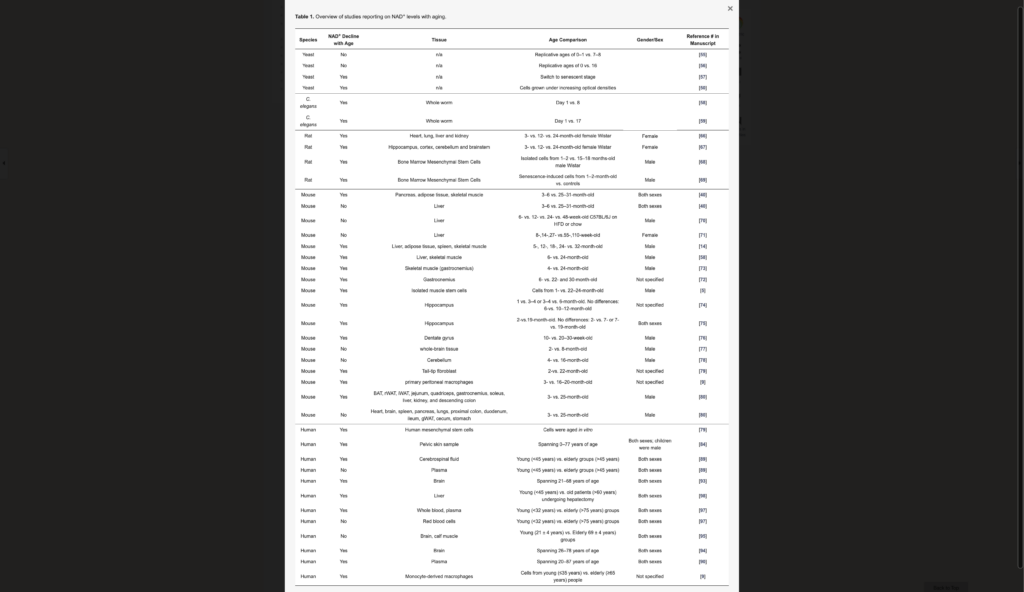
A table in the review showed the variability in the research, split into sections for different species. I have condensed it even further into the following table to show an overview:
| Species | Studies showing decline |
|---|---|
| Yeast | 2/4 (50%) |
| C. elegans | 2/2 (100%) |
| Rat | 4/4 (100%) |
| Mouse | 12/18 (67%) |
| Humans | 9/12 (75%) |
We can see here that in the pooled data, NAD+ levels declined with age in humans in 75% of studies prior to 2022.
The review also looked at limited evidence in rhesus monkeys suggesting an increase in NAD+ with age, with middle-aged monkeys having 2x more, and elderly having 2.5x more.
Not only that, but even in the studies showing decline, there is significant variation in the amount of decline. The reviewers go into several examples in the human data where the difference in NAD+ levels between young and elderly people is only 10-20%. That’s very different to the 80% claim we see floating around.
Finally, the reviewers concluded that there may be an unintentional selection bias in the published evidence, because researchers may be less likely to report on a biomarker when it doesn’t change. It’s just not as interesting as the ones that do change. If that’s true, it means the true numbers from all gathered data could be very different to those in the table.
The new study
The new study making headlines used 7 separate cohorts, so we could either include it in the table as 1 study to bring the percentage down to 69%, or as 7 studies to make it 47%8.
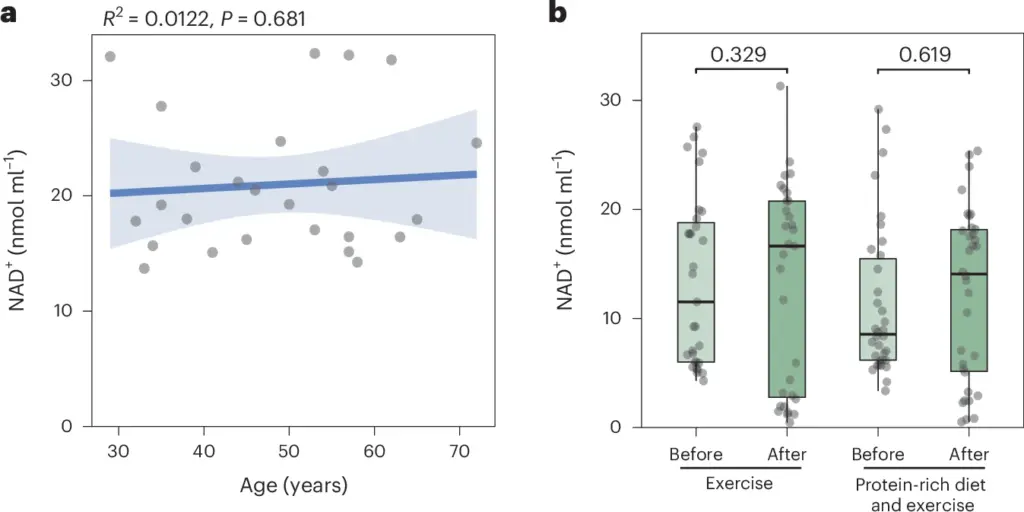
This study is noteworthy for a few reasons.
Firstly, having 7 separate cohorts validating each other’s information is amazing. For comparison, the Interventions Testing Program, which is deservedly seen as one of the most rigorous testing programs in the world, uses 3 separate mouse cohorts for each test9.
Across the cohorts, there are 303 participants, randomization, single-blinding. It’s published in Nature Metabolism by 32 authors from the Netherlands, Spain, Finland, and Australia.
They even made the discovery that freezing and thawing blood samples reduces NAD+ levels, which might account for some of the variability across previous studies, and will certainly lead to improvements in future studies.
Conclusion
Overall, this research paints a picture that NAD+ might not decline with age, but we should be careful not to overinterpret the results.
This is not the same as saying that low NAD+ levels are a good or bad thing, it just means that the logic of:
it goes down with age, so you should supplement its precursors as you get older
might not be right, especially since higher levels of NAD+ might also feed cancer cells10.
It could make sense to transform that logic into:
you should measure and track your NAD+ levels, and if they get too high or low, intervention might be a good idea
I’m trying to get more subscribers, so please consider subscribing for more content like this.
I’m also interested to know whether this research has changed your supplement stack, and whether you like this kind of article where I interpret and give context to popular new research. Let me know in the comments.
- NAD probably doesn’t actually decline with age – Matt Kaeberlein ↩︎
- New Research Upends the Argument for a Popular Longevity Supplement ↩︎
- NAD+ Levels in Healthy Aging: New Study Reveals Surprising Trends ↩︎
- Why NAD+ Declines With Age: Sirtuins, PARP & DNA Repair Explained ↩︎
- How NAD declines with age and why it matters ↩︎
- Is NMN Worth Taking? ↩︎
- Age-Dependent Decline of NAD+—Universal Truth or Confounded Consensus? ↩︎
- Human whole-blood NAD+ levels do not vary with age or lifestyle interventions ↩︎
- Interventions Testing Program ↩︎
- Advances in NAD-Lowering Agents for Cancer Treatment ↩︎