
In a study co-authored by Steve Horvath, a 105-year-old was found with a biological age of 601. There were two other centenarians with remarkable differences, one at -36 years, and one at -28 years.
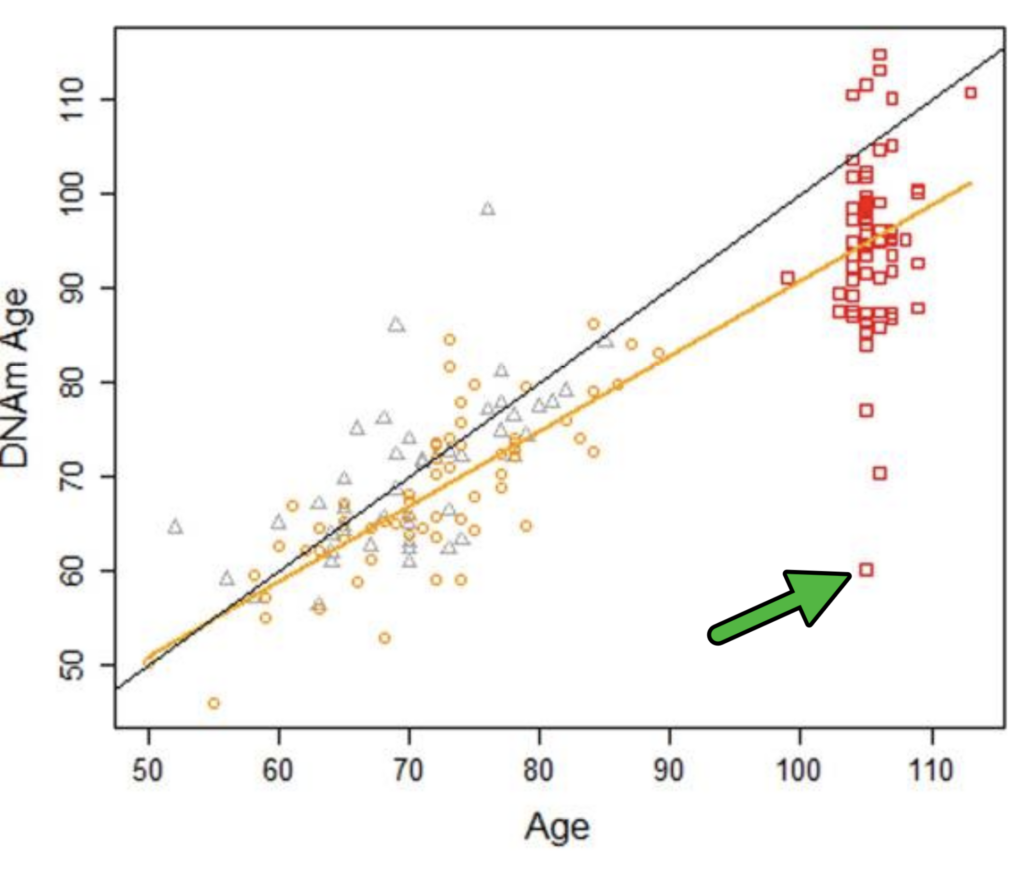
That’s 3 people with 28-to-45-year lower biological ages!
To put that in perspective, the biggest difference between biological and chronological age in the Longevity World Cup so far is 22.1 years, achieved by Mike Lustgarten last year, with a Phenotypic Age of 30 at an age of 522.
So these 3 people might have taken over the entire podium if they had entered.
The study also found that on average, centenarians are 8.6 years younger biologically than chronologically.
Of course, when we say “biologically younger” what we really mean is more like “their predicted mortality risk is lower“, not that their entire body is identical to a 60-year-old. Biological age is a misleading term that causes a lot of confusion and debate, when it should really be called risk-equivalent age3.
Still, if anyone knows people like that, you should get them to join a longevity competition and get some free money!