For the video version of this article, see it on YouTube, or ad-free on Patreon.
The supplement and research company DoNotAge has released a once-per-day powdered drink mix that they claim impacts every hallmark of ageing1. It goes without saying that is a huge claim.
We’re going to look into this claim, the ingredients, the related scientific research, and whether this is a good product for people to take in general.
There are a few of these so-called “longevity drinks” on the market now with significant overlap in their ingredients. I’ll be comparing the doses in this DoNotAge mix with the following mixes:
- Bryan Johnson’s Blueprint Longevity Mix
- Dr. Brad Stanfield‘s MicroVitamin+
- Novos Core
- Renue by Science‘s Skin Essentials
- Simply Nootropics‘ Vital Beauty
There are many more, but I chose this list because they’re all third-party tested and pretty popular.
I’ll be releasing this review and comparison in parts; one article per ingredient, then at the end, we’ll look at how the ingredients work – or don’t work – together, so make sure you subscribe to see the other parts.
Initially I started writing one long article with everything in it, but this DoNotAge drink is mostly a mix of the existing DoNotAge capsules, and I want to do a deep dive into each one without rushing or cutting corners.
Overview
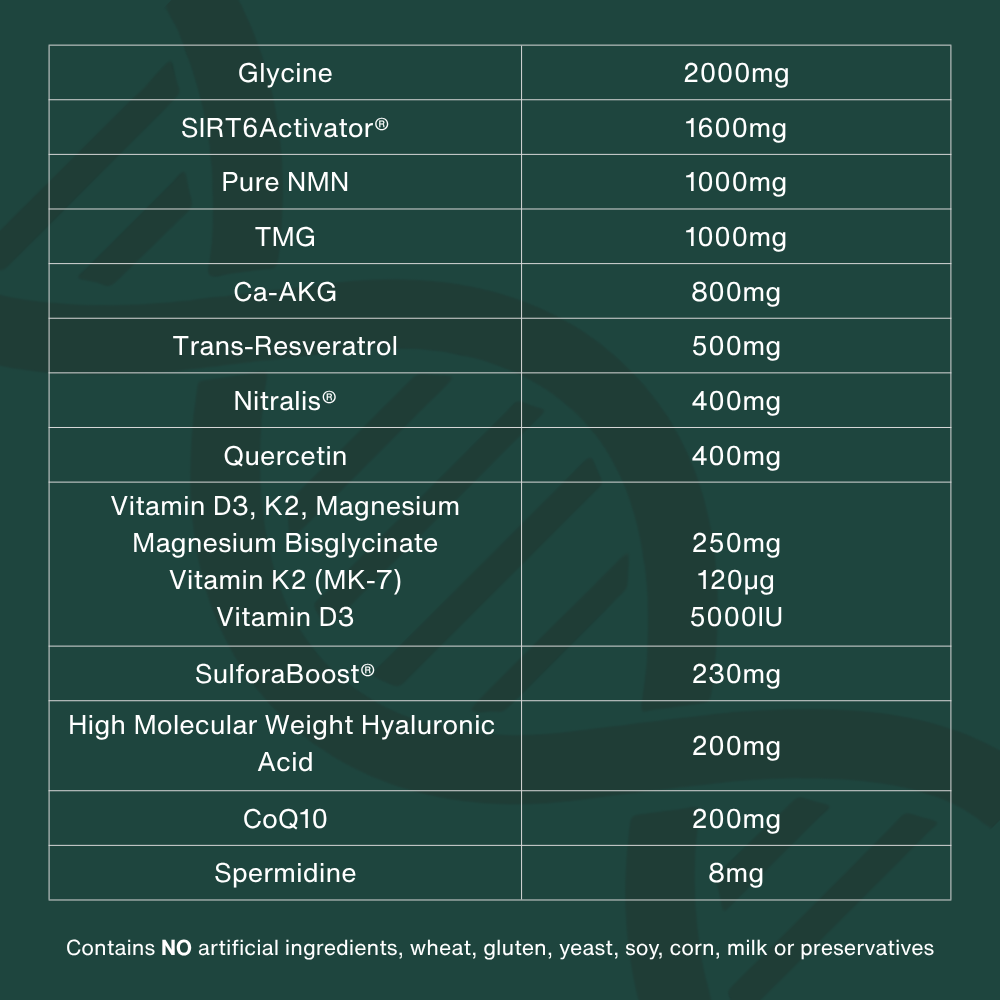
This is the list of 15 ingredients in the drink. I say ingredients, but you’ll notice that 3 of these are hidden behind registered trademarks, which is a red flag for me, and obscures the ingredient doses.
They seem to like registering things. Even their slogan The Health Research Organisation is registered, which I also find strange, but ok, let’s dive into the first ingredient on the list:
Glycine
A 2025 review in Metabolism stated that glycine is a conditionally-essential amino acid, and that:
Glycine plays an essential role in the synthesis of proteins, purines, porphyrins (e.g., heme), creatine, and GSH and neurotransmission, cytoprotection, and conjugation of bile acids and xenobiotic organic acids2.
It has also been seen in a 2025 clinical trial to reduce triglycerides, ALT, and AST when supplemented in severely obese individuals at a dose of 100 mg/kg/day3. At an average weight of 108kg per individual, that’s about 11g per day.
That dose is in the range proposed for optimal glutathione production and collagen turnover.4
An incredibly thorough review in GeroScience looked at the available evidence, assessed and sorted it by quality, and produced this infographic:
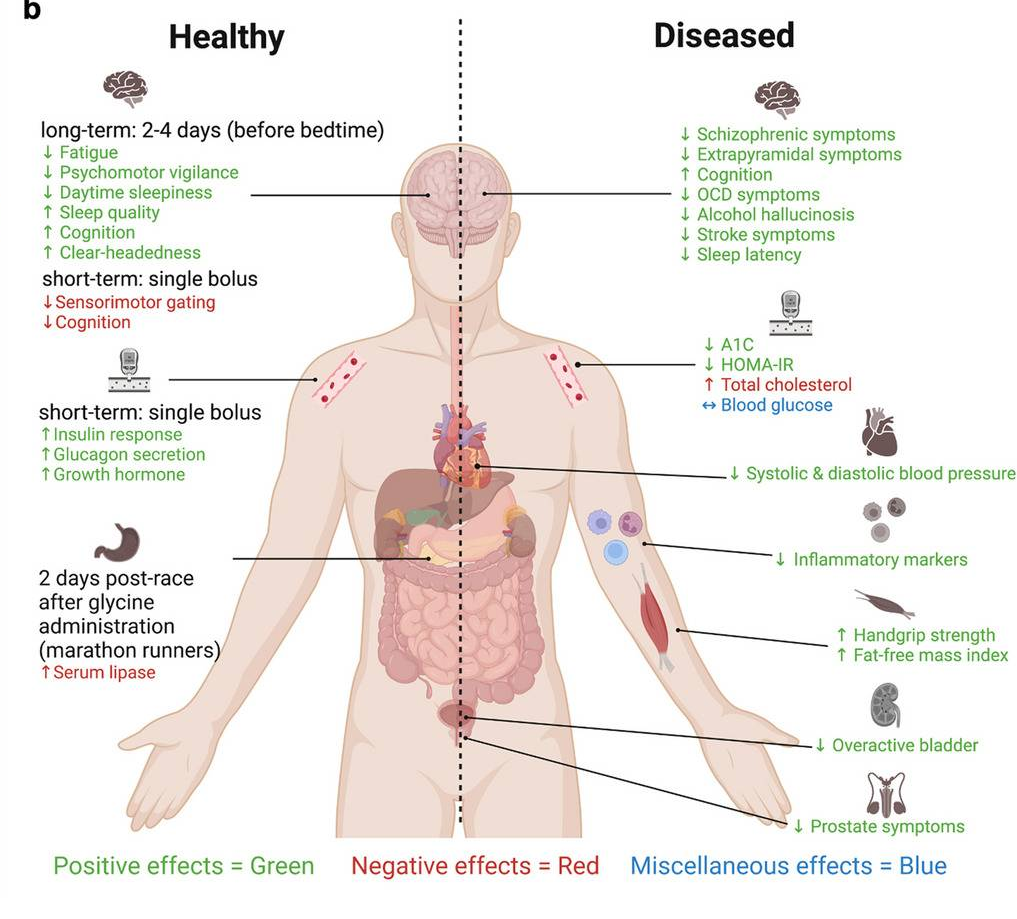
Their main findings in healthy individuals was that it improved sleep quality, reduced daytime fatigue, and improved insulin responses.
In diseased individuals, they found even more benefits, like reduced A1C (a measure of glycation, commonly used to estimate average recent blood sugar levels), HOMA-IR (insulin resistance), blood pressure, inflammation, overactive bladder, and increased grip strength, fat-free mass, stroke symptoms, and OCD symptoms.
Negative effects were most often found in short-term or high-dose studies, so that gives us an indication that we should be careful about the dose being too high.
The reviewers also note that:
Nutritional studies have highlighted that the amount of glycine available in humans and animals is inadequate to satisfy metabolic requirements, suggesting the need for dietary glycine supplementation5
Glycine modestly extends lifespan in worms, male and female mice (by 4-6%6), and rats.
It also mimics methionine restriction7, which is associated with a host of health benefits including:
- Anti-cancer
- Anti-aging
- Anti-inflammation
- Anti-obesity
- Cardiovascular protection
- Intestinal improvement
- Liver protection
- Brain health improvement8
The DoNotAge drink mix has 2g of glycine, which is a little lower than the 3g most studies have looked at, and far lower than the 11g dose we looked at. Lately I have been taking 5g per day, so this might be slightly underdosed, but that might be because this drink formula also includes TMG and magnesium bisglycinate. We’ll get to those soon.
Glycine also has a sweet taste, so it makes sense as an ingredient in a drink mix. The word glycine itself comes from the greek word γλυκύς, pronounced glykys, which literally translates to “sweet“. I even use it as a sweetener in baking. It’s great to have a sweetener option that is actually healthy, instead of just less bad than others.
Product comparison
So how does the DoNotAge dosing compare to the other mixes?
| Product | Dose |
|---|---|
| Blueprint Longevity Mix | 1.2g |
| DoNotAge Routine | 2g* |
| Dr. Brad Stanfield MicroVitamin+ | 4g* |
| Novos Core | 2g |
| Renue by Science Skin Essentials | 7g* |
| Simply Nootropics Vital Beauty | 5g* |
All of the mixes contain glycine, either directly or indirectly.
The lowest amount is in Blueprint with 1.2g, which is quite low.
Then we have this DoNotAge mix and Novos Core, both on 2g, which is also on the low side.
Next are the Simply Nootropics and Brad Stanfield mixes, with 4-5g. Neither of them have glycine directly, but they have collagen peptides, which are 1/3 glycine9, as well as other glycine-bound ingredients.
Finally there’s the Renue by Science mix with 7g total, which is on the high side.
The winners for me in this round are Simply Nootropics’ Vital Beauty and Brad Stanfield’s MultiVitamin+. They match the dose I’m currently taking.
Conclusion
Glycine is a sweet choice, but it’s slightly underdosed in this DoNotAge mix, so I rate it 4 / 5.

Coming Up Next
Next time we’ll look at the SIRT6Activator.
Do you think it will score as well as glycine did? Did I rate glycine too high? Let me know in the comments, and make sure you subscribe to see more of this series.
- DoNotAge website ↩︎
- Glycine as a conditionally essential amino acid and its relationship to l-serine ↩︎
- Metabolic impact of dietary glycine supplementation in individuals with severe obesity ↩︎
- Branch-point stoichiometry can generate weak links in metabolism: the case of glycine biosynthesis ↩︎
- The effect of glycine administration on the characteristics of physiological systems in human adults: A systematic review ↩︎
- Glycine supplementation extends lifespan of male and female mice ↩︎
- Glycine and aging: Evidence and mechanisms ↩︎
- Methionine restriction diets: Unravelling biological mechanisms and enhancing brain health ↩︎
- Collagen – DermNet ↩︎
How should glycine be taken for maximum absorption? AI says on empty stomach. If its combination with NAC causes stomach irritation take with small amount of non protein food.
Don’t all these ingredients have different absorption requirements? Some should be taken with fatty foods
Hi Mela, that’s a great thing to think about! I’ll be releasing the next parts in the series very soon, and I’ll make sure to include absorption in them.
I’d say it’s even more complicated than just maximizing absorption, because with many compounds (particularly hormetic ones, which is a lot of them), you wouldn’t want to maximize the absorption more than what is done in the clinical trials. That can be an easy way to turn a beneficial dose into a toxic one. That’s one reason I stopped taking liposomal capsules a while ago, it seemed like a good idea but it also really increases risk and bypasses our bodies’ ability to protect and regulate intake.
Hope that helps!